

While OEMs race to deploy AI, IoT, and 4IR (Industry 4.0 technologies), Oxford University research reveals a critical insight: manufacturers with human-centric transformation approaches are 260% more likely to succeed than those leading with technology. The companies winning the digital race aren't the ones with the best computer algorithms, they're the ones who've mastered human algorithms. People, not simply platforms, are the key to operational success.
The metrics you’re tracking may not show the full picture. While you're tracking ROI, scheduled milestones, and technical performance, the companies achieving 12x better transformation outcomes are monitoring something entirely different: the collective emotional energy of their workforce.
This is actionable operational intelligence that prevents line-downs, quality failures, and supplier disruptions before they appear in traditional KPIs. New research from Oxford's Saïd Business School and EY, analysing 1,646 transformation leaders across 16 industries, identifies six human-centric conditions that can increase transformation success rates from 28% to 73%.
This article distils the key findings from this "Transformation Leadership; Navigating Turning Points" research. And here's what Applied Materials, Volvo, and other manufacturing leaders (who are featured as case studies) discovered when they stopped asking "How can people adapt to our technology?" and started asking "How can technology make our people better?"
OEM Transformation By the Numbers
– In 96% of cases transformations go off-course, forcing leaders to intervene or projects to falter.
– Human-centric approaches deliver 260% better outcomes than technology-first strategies.
– Six proven conditions turn workforce into a competitive advantage, and alter the landscape of transformation within organisations fundamentally.
– 12x performance gains are possible through systematic turning point navigation (from 6% to 72%).
The Technology Trap: Why Smart Factories Still Fail
The seductive technology myth promises that deploying cutting-edge automation will naturally lead to transformation success if you simply train your workforce to adopt and adapt. Yet Applied Materials learned this approach can create major setbacks when their world-class robotic process automation (RPA) implementation nearly derailed despite having one of the world's leading RPA suppliers come in to lead the transformation.
The breakdown was human, not technical. Only by sitting in on the early workshops did the transformation leader notice the issue. "The only way I was able to ascertain whether this was a signal versus just noise was being in the room".
The RPA supplier didn't have the necessary knowledge required for the team, with employees going quiet having lost confidence in an external partner, causing near derailment of the whole transformation project. This pattern repeats across manufacturing with predictable frequency.
This recent research reveals that 96% of transformation programmes experience critical 'turning points' where human factors determine success or failure (U. Oxford Saïd/EY Research). When these moments are navigated successfully, they can improve transformation performance 12x, from a 6% to 72% success rate.
Problem:
Technology implementations without workforce buy-in create expensive failures.
Solution:
Treat human behaviour change as operational intelligence, not an afterthought.
Volvo's mixed-model assembly line for electric and combustion vehicles was technically well-designed, but when human dynamics started breaking down in practice, their transformation faced significant challenges. Their recovery approach, prioritising workforce collaboration over technical perfection and being open and accepting of 'people's noise' meant the whole team started collaborating together, rather than being stifled by a management edict they had no idea how to implement.
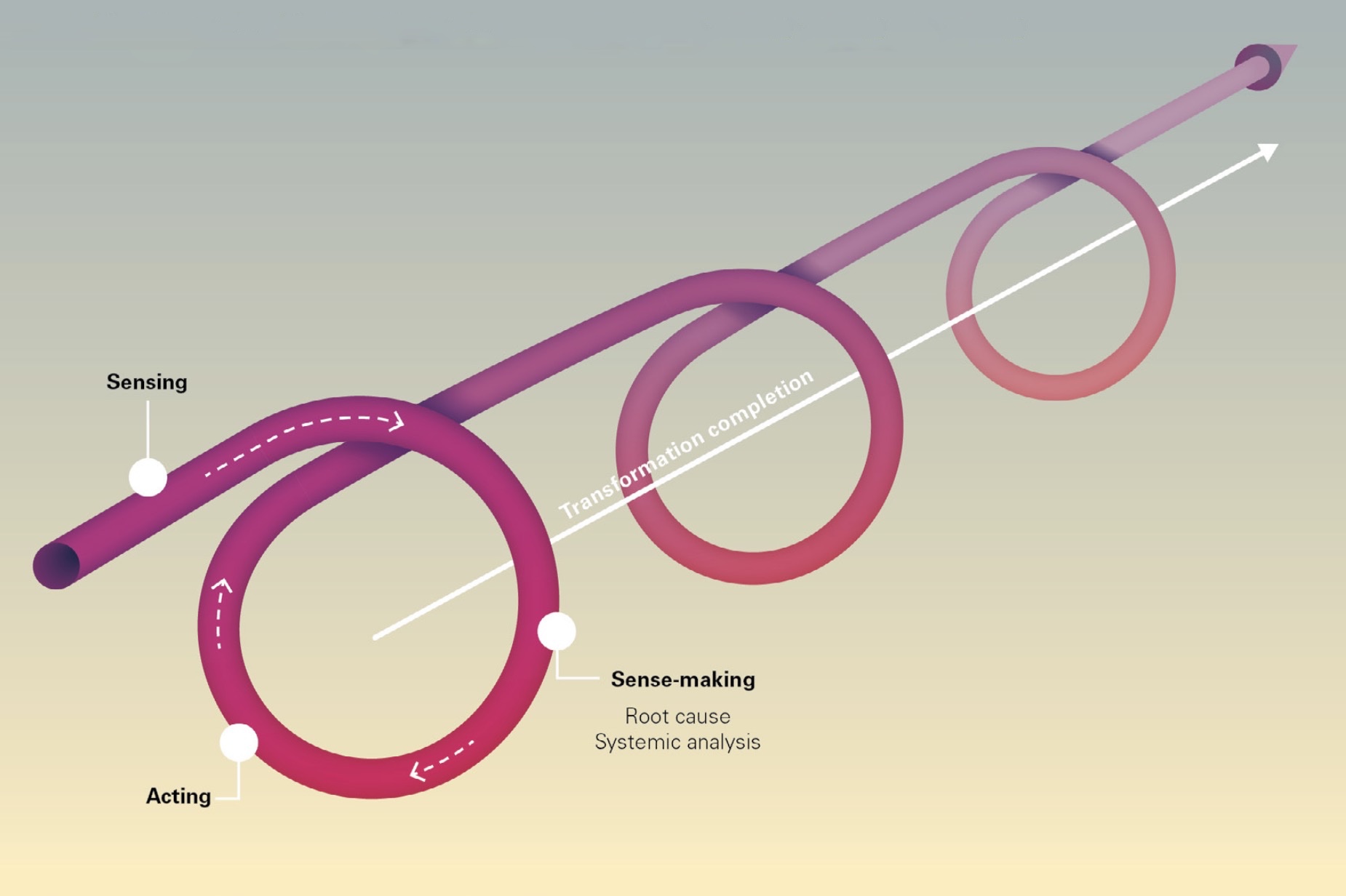
Three phases to transformation performance
Graphic: Oxford Saïd
The Three-Phase Turning Point Navigation System
The likelihood of avoiding a critical moment in manufacturing transformations where leadership intervention determines success or failure is 4 in 100. Rather than trying to avoid these moments and defy the odds, this research shares compelling evidence that successful manufacturers have developed systematic approaches to navigate them. In so doing, they've turned potential disasters into competitive advantages. It suggests a three phase system, and six conditions that can transform outcomes successfully.
Phase 1: Sensing
Your most valuable warning signals aren't in your company dashboards, they are in your workforce. The research reveals that behavioural indicators represent the majority of signals highlighting transformation issues.
By moving from lag indicators (KPIs) to leading indicators (Key Behavioural Indicators, or KBIs) companies can more than double their transformation performance and success rates. Top signals to watch out for: lack of clarity on how to proceed (37% of turning points), delays and missed milestones (37%), ineffective collaboration (32%), increased negative emotions (31%), and decreased engagement (31%).
Production line efficiency changes manifest first in worker behaviour. Supplier relationship tensions appear in communication patterns before formal metrics detect them. Quality issues are preceded by workforce stress indicators that trained supervisors can identify.
Leaders subconsciously pressure programmes to move forward while ignoring red or amber flags, and think that people will feel safe speaking out to signpost them. They need to be proactive in eliciting feedback from workforce, and take the initiative in creating a safe environment where problems can be called out fast and addressed quickly and effectively.
Phase 2: Sense-Making
Once signals are detected, successful manufacturers avoid the default management-only diagnosis trap. Instead, they involve the collective workforce in understanding issues and co-creating solutions. There's a 66% improvement in transformation performance when the full team is involved in understanding issues and providing a course of action.
What drives effective sense-making? First, continue transformation momentum while diagnosing problems (62% vs 44% success rate for those who pause operations). Second, collectively involving workforce rather than just leadership to get shared understanding and effective root cause analysis.
Volvo's collaborative sessions demonstrated this approach: "A decision was taken to move responsibilities closer to where the information is, that is, from head office/global to the manufacturing plants/local … creating powerful local teams with the decision-making authority. By creating strong and competent teams focused around critical problem areas, the team was able to minimise the risk of moving forward without having clarity on all the details of the deliverables beforehand."
Making sense of and providing solutions to solve these challenges together strengthens teams and creates a highly positive and performant company culture.
Phase 3: Acting
The final phase involves acting quickly and often in concert with sense-making, so management and teams can test, learn, and iterate, to influence the conditions of success in timely and effective ways. The acting phase requires putting these 'human algorithms for effective transformation' that follow below into motion.
The Six Human Algorithms That Drive Manufacturing Success
1. Purposeful Vision: Connect Daily Work to Strategic Outcomes
Technology implementations fail when your workforce can't connect their daily tasks to transformation outcomes of an idealised future. Applied Materials (the semi-conductor manufacturer) discovered this when they moved from high-level strategic discussions to specific ownership and examples: "This is your automation. You own its success; you own its failure".
The result? One manager noted that workforce engagement transformed when people understood exactly how their work contributed to broader goals. The numbers support this approach: 62% of successful transformations meant close collaboration with workforce to make the transformation vision clearer and more compelling, compared with just 30% of unsuccessful initiatives. Aspirational visions need to be redefined to become everyday reality with workforce input. Legacy organisational vision needs to re-align to end goal transformation and delivery to make real change.
These actions translate to a 2.1x higher likelihood of over-performing target KPIs when people understand the "why" behind the "what".
Problem:
A workforce disconnected from transformation purpose creates resistance.
Solution:
Share ownership of outcomes, not just processes.
2. Psychological Safety: Your Workforce as a Warning Indicator
Quality issues, line-downs, and supplier problems are detectable before they appear in production data. That is, if you know how to listen. The research reveals that sudden shifts in the emotional energy of groups serve as signals that something is wrong, while individual emotional changes are typically just noise.
At ANZ (a multi-national Australian Bank), teams showing burnout symptoms predicted system failures before technical metrics caught them: "After the system went live it was almost like the team hung on until the end. The system went live and then the two key people both fell in a heap at the same time". They also found that under stress when language shifted to an accusatory "you" rather than "us", programmes stalled out.
Companies investing more time and resources in the emotional state of their personnel, fostering trust, and building a growth-mindset culture, achieved 200% better transformation outcomes by creating environments where problems surface early and are able to be addressed quicker, rather than being left or ignored to fester.
Problem:
Traditional metrics detect problems too late for effective intervention.
Solution:
Monitor workforce emotional energy as a leading operational indicator.
3. Adaptive Leadership: Presence Over Rigid Process
Hierarchical decision-making kills transformation speed when real-time adaptation is required. Team alignment is needed. Leaders who maintain physical, intellectual, and emotional presence with teams achieve 190% higher success rates in tough decision-making under pressure.
This isn't about abandoning structure, it's about bringing decision-making authority closer to operational reality. Volvo's transformation succeeded when factory leaders organised 'Kaizens', continuous improvement meetings, where teams shared challenges and co-developed solutions.
This moved decision-making authority from head office to manufacturing plants, creating "powerful local teams with the decision-making authority" to respond quickly to changing conditions.
All the case studies showed leaders who fostered the right team dynamics had successful turning points in transformation projects. Collaboration and approaching challenges innovatively were key to overcoming adversity.
Problem:
Slow and distant executive decision-making delays transformation response.
Solution:
Distribute decision authority to teams closest to operational reality.
4. Disciplined Freedom: Exploration With Execution
The challenge isn't choosing between rigid processes that prevent adaptation or unlimited experimentation that creates chaos. Successful manufacturers create structured experimentation with clear boundaries, pushing ownership as far down the organisation as possible. The result according to this research: a 59% increase in successful process innovations and learning.
Rio Tinto (the metal and mining giant) and their use of a 'lighthouse' approach offers a strong demonstration of this principle. They established testing facilities where "the lighthouses were a testing ground for the imperfect but that was as good as we could get it. When people used it, they had lots of ideas on how to improve".
The team captured these ideas and improved performance from 60% to 80%, then deployed the approach to more facilities and reached 95% effectiveness. This controlled experimentation enables continuous improvement while maintaining operational stability.
Teams that spent extended periods forming plans and thinking together to understand the issues delivered the most effective outcomes.
Problem:
Need for innovation conflicts with operational stability and hierarchies.
Solution:
Create testing environments that enable safe experimentation.
5. Collaboration: Silo's Get Beaten by Shared Ownership
Department silos prevent the end-to-end optimisation that modern supply chains demand. Cross-functional cooperation mechanisms with shared incentives achieve 64% improvement in cross-organisational collaboration.
At Applied Materials, this meant redefining the operating model between different organisational divisions to create "a very collaborative effort that people were problem solving and not blame fixing. That has reinforced the defined roles and responsibilities and everyone knows how to operate together now".
The research found that 61% of successful transformations adjusted organisational structures to encourage collaboration across key parts of the organisation, compared to 30% of unsuccessful ones. This structural change creates the foundation for sustained transformation success.
The key insight: Deliberately design collaborative working practices by setting goals that require teams work together.
Problem:
Functional silos limit supply chain optimisation and responsiveness.
Solution:
Design shared incentives and structural changes that reward collaboration.
6. Purposeful Technology: Level Up Human Expertise
There's often a gap between the capability and operations of today's technology with future aspiration. And to get the most out of these new technologies human capabilities need to be plugged in and levelled up to utilise them effectively.
Better aligning technology and transformation objectives to human capabilities can help bypass technological constraints and lead to a 2.2x increase in effective turning points.
Applied Materials discovered that early technology demonstrations were crucial. One manager noted: "I was a little surprised at how much of the upfront education and discussions to lay the foundation, how little an impact that had. It was really once they're building the bot and personally experiencing the successes and failures before it clicked."
Companies deploying early examples of technology to show potential value achieved 200% better transformation outcomes.
The bottom line: people need to experience technology benefits firsthand before committing to wholesale adoption. They need to be reminded how the technology connects to the overall company vision.
Problem:
Technology deployments that ignore human learning preferences create resistance.
Solution:
Design technology experiences that demonstrate value through hands-on interaction.
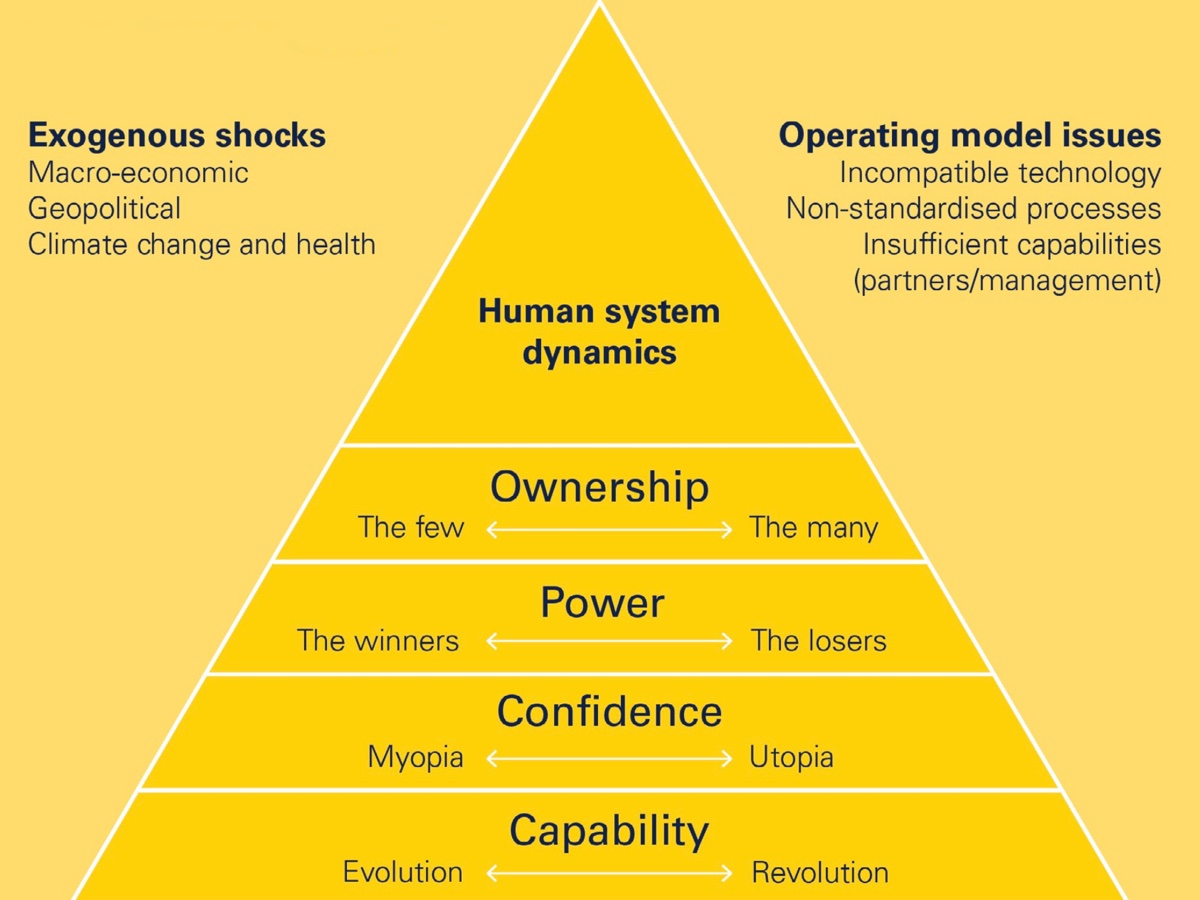
Root causes of turning points
Graphic: Oxford Saïd
Measuring Success Through KBIs and KPIs
Leading Indicators: Key Behavioural Indicators (KBIs)
Track workforce transformation engagement through participation rates and suggestion implementation. These metrics predict technology adoption success.
Monitor emotional energy through team energy levels and collaboration effectiveness. This provides early warning for operational problems.
Assess supplier relations through communication quality and problem resolution speed. This prevents integration failures before they impact production.
Measure innovation activity through improvement initiatives and experimentation cycles. This enables systematic capability building.
Enhanced Traditional Indicators: KPIs with Human Context
Traditional metrics like OEE (overall equipment effectiveness), cycle rates, defect percentages, and cost reduction become more predictive when correlated with workforce behavioural data. Quality issues are preceded by workforce stress indicators that trained supervisors can detect.
Traditional quality metrics become more actionable when analysed alongside team communication patterns and psychological safety scores. This correlation reveals patterns invisible to standalone technical metrics.
Transformation-Specific Success Metrics
Track turning point navigation effectiveness through the percentage of challenges resolved using the three-phase process.
Monitor improvements in cross-organisational collaboration to measure the breakdown of silos limiting efficiency.
Assess human-technology integration success through workforce adoption rates paired with capability development progress.
These metrics quantify the competitive advantage created by human-centric transformation approaches.
Your Next Strategic Move
So what does the research show us?
Anticipate and embrace turning points as natural challenges.
Track key behavioural indicators (KBIs) to understand how healthy the heartbeat of an organisation is, and consequently tackle the most transformative projects most effectively.
Leadership is about listening effectively.
Leaders need to build high trust relationships, gather holistic intelligence and engage proactively with teams and the company workforce.
You might be the blockage.
The most critical factor to address could be the suppression of free-flowing communication by management. The new archetype of leadership requires emotional presence.
Allow people to thrive through collaboration.
Energy and motivation can be unlocked if leaders share ownership over projects and involve teams in strategy and improvement.
Test and learn together.
Create a shift in culture where people within the company test and learn how vision can work in practice through experimentation and new initiatives.
Everything's an iteration.
Successful adoption of transformation projects require them to become embedded within organisations. This means there's no end, just added improvements and re-directions along a pathway to excellence.
The factories of the future won't be run by robots, they'll be run by humans who've learned to work with robots, think with data, and transform with purpose. This Oxford research provides manufacturing leaders with a fundamental strategic choice:
Continue the technology-first approach that provides underperforming transformation outcomes, or embrace the human-centric methodology that achieves 260% better outcomes. The strategic imperative extends beyond internal operations.
When your workforce feels psychologically safe to identify problems early, when your teams collaborate effectively across functions and with suppliers, when your technology amplifies rather than replaces human expertise … then you're not just improving transformation success rates.
You're creating operational resilience that directly benefits customers through more reliable delivery, higher quality, and more responsive service.
The question isn't whether you'll automate, it's whether your people will lead the automation or be led by it.
Case studies from companies including Applied Materials, Volvo, and Rio Tinto discovered that putting humans at the centre of transformation doesn't slow down digitisation, it accelerates it, by ensuring technology implementations stick, that they can scale, and aren't a one-shot process but one of continuous improvement.
While competitors struggle with failed transformations, quality issues, and supplier disruptions, manufacturers implementing these six human-centric conditions build early warning systems that prevent problems before they impact customers.
The result: production and supply chain excellence.
How Acorn Helps You Implement Human-Centric Transformational Logistics
At Acorn, we understand that successful supply chain transformation requires more than just technology, it demands partnership built on trust, transparency, and shared success. Our VMI, assembly, and 3PL solutions embed these human-centric principles from day one.
We endeavour to make your people more powerful, not just your processes. Our logistics and inventory services are designed to enhance clarity, confidence, and control on the factory floor, with your inventory and warehousing capabilities, and throughout your supply chain.
Because we believe that when your people have what they need, when they need it, performance follows.
Sources
— Saïd Business School, U. of Oxford/EY Transformation Leadership Research: "Navigating Turning Points" (2024)
Further Reading
— Intelligent Manufacturing Supply Chains: Unlocking The AI Productivity Paradox
— OEM supply chain transformation for competitive advantage
Transform your supply chain with Acorn
Want to hit the sweet spot between strategic wins and practical implementation?
At Acorn we invest in the skills and state of our people so they can do the best for your people. Creating a better service for you means designing bespoke supply chain solutions that transform your supply chain performance.