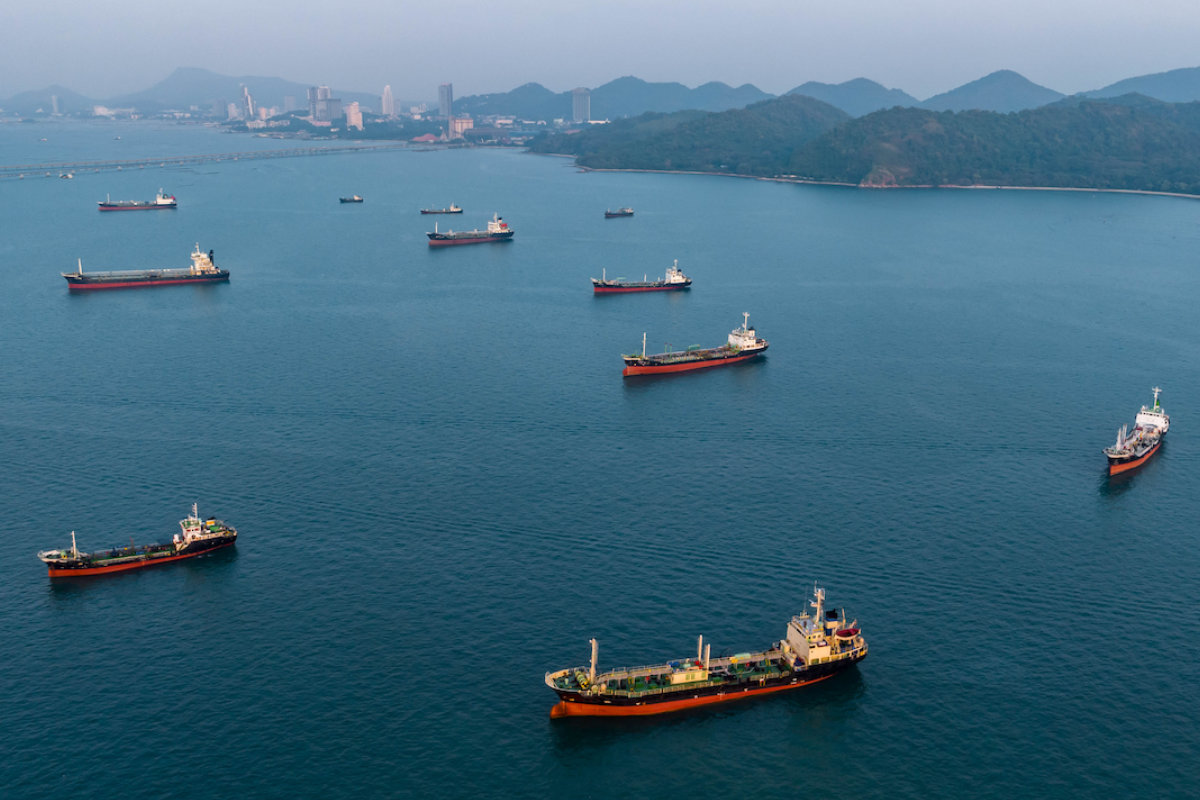
Global disruptions affecting supply chains are no longer episodic. They are the ‘new normal’, with a current cadence of a major structural shock every year or so. This means logistics strategy needs to be rethought. On 28 February 2026, Israel and the USA began the latest Iran conflict with a series of strikes around that country. And while a conditional ceasefire was declared on 8 April, as a major chokepoint for 20% of the world’s oil with vital shipping routes, normal flow has not returned, and it remains effectively closed (at the time of publication). It has become the major negotiating pawn in the conflict. The IEA has already said this is the largest supply disruption in the commodity’s history.
This conflict isn’t an isolated event, though. The Hormuz blockade is the latest in a series of challenges to worldwide trade, freight and supply. In the same region, on the other side of the Arabian Peninsula, trade along the Red Sea is continuing to be disrupted due to Houthi rebel attacks from Yemen. Transits along the Suez Canal were down 60% in 2025, and are only now recovering to around 20% below baseline. Layer in the Pandemic, the six-day Suez blockage due to the grounding of the container ship, Ever Given, and the ongoing energy fallout from the Russia-Ukraine conflict, and the picture is one of unravelling stability.
Global supply chains have become used to operating without margin for error as the system has been over-optimised. That model assumed stability, which means the system is now breaking. Stability in these worldwide networks no longer exists.
For manufacturers, oil isn’t the lead story (even as energy prices directly affect costs). It is about lead-time, about production risk, about supply reliability. Longer lead times and unpredictable freight patterns, along with component shortages, change the logistics game. Each disruption exposes fragilities in the system and in a company’s supply chain.
But the organisational responses are near universally the same. With each disruption, solve it by adding stock and adding suppliers. Yet this doesn’t create inventory clarity or production resilience, just more complexity that will inevitably break.
If more stock and more suppliers aren’t the answer, then what is?
"The strongest OEM supply systems are not managed as disconnected functions. They coordinate inventory, logistics and replenishment before disruption reaches production."
The response pattern is the real story, not the disruption
Disruption grabs the headlines. It creates anxiety to ensure production lines stay up and assembly continues. It can induce a panic response that creates greater long-term damage while patching things up straight away.
Almost 80% of organisations experienced supply chain disruption in the past year, with most facing between one and ten incidents (BCI Supply Chain Resilience Report 2024). Nine out of ten supply chain leaders cite disruption as a key challenge (McKinsey Global Supply Chain Leader Survey 2024).
The playbook to deal with this for procurement departments? Buy safety through more inventory. Add fallback suppliers. Develop regionalisation to navigate around trade barriers and tariffs. It’s a triple play favoured by 97% of supply chain leaders (McKinsey, 2025).
On the surface, it’s a safer, rational strategy. Scratch a little deeper, and we uncover the same pattern: buying resilience and agility that essentially papers over the cracks that can cause operational and system breakdowns.
These breakdowns stem from five key mistakes.
Five mistakes most OEMs make under supply chain pressure
Mistake 1: Inflated inventory lowers visibility
Loading up on inventory has become the default response to uncertainty. Lack of control and visibility is actually the underlying cause that bloated buffer stock is attempting to address.
45% of companies are actively increasing inventory levels, 34% say they rely on larger buffers, and 6% want more but are constrained by cash (McKinsey 2025, 2024). This strategy keeps the company blind to the real supply chain issues that need to be addressed. It’s a suboptimal fix that becomes constrained by cost (it becomes frozen capital, potentially wasted entirely when inventory becomes obsolete).
Inventory absorbs variability and smooths supply issues. It buys time and the illusion of control. It doesn’t solve for supply chain fragility and supplier issues two or three tiers down. Excess inventory actually reduces a manufacturer’s ability to invest in the capabilities that address inventory issues head-on, such as supplier visibility, tracing and tracking beyond tier-1 suppliers, and supply alert systems. Bloated inventory creates warehouse congestion, duplicated stockholding and slower logistics flow.
Mistake 2: Multiplying suppliers without supply knowledge
Most OEMs have a strategy to increase the number of suppliers to improve deliverability under operational stress. This often creates weaker overall relationships, with a shallower understanding of each party's capabilities and less situational intelligence.
Dual sourcing strategies have become commonplace (73% report progress in this area according to McKinsey), but only 60% have comprehensive tier-1 visibility, and that figure deteriorates rapidly for tier-2 and tier-3. Companies are adding suppliers as ‘diversification insurance’ without understanding them or the web of interdependencies. They are spending more on dashboards and expanding their supplier base, but getting less ‘visibility’ (which means less actionable business intelligence).
Most supply chains are not independent systems, so geographic diversity at tier-1 doesn’t solve for concentration or dependencies beyond this point, where the same materials, sub-components and processing are needed. Increasing suppliers, with the increased complexity of managing and integrating them, does not mean deeper capability or automatically better resilience.
Mistake 3: Reshoring as fake geographical insurance
Moving production closer to manufacturing and assembly is being mistaken for a reduction in risk. Put simply, reshoring is not a shortcut to control. Shorter geographic supply chains should be more robust. That’s why 73% of large European and US organisations now have a reindustrialisation strategy in place or in development (Capgemini 2026). The strategy is becoming near universal, but effective execution is not.
Domestic production should reduce exposure to international geopolitical turmoil. Yet once again, hidden dependencies override initial logic. Reshored production still requires input from globally sourced materials. We can see it from the ongoing controlled supply of rare earth materials from China to the more recent helium supply crunch in the Arabian Gulf. In some sectors, reshoring concentrates production within a smaller domestic supplier ecosystem with less redundancy than the global networks it replaces.
Distance is reduced, but dependency on different parts of the system where processes, materials, or sub-components are constrained is not. In addition, reshoring can introduce a different set of risks, such as local skill shortages, limited supplier depth, and bottlenecks in local capacity.
Clarity on supply intelligence, dynamic buffer management, and tiered visibility remains critical. Geography matters less than logistics control.
Mistake 4: Measuring resilience against the wrong metrics
With more supply chain pressures and uncertainty, resilience in the OEM supply chain is at a premium. Unfortunately, internal factors are still measuring against this and the old optimisation frameworks.
Historically, cost efficiency has been the dominant driver of performance. Costs for labour, working capital, components, and materials are easily compared, and savings and efficiencies are rewarded. A 2025 Deloitte survey of Chief Procurement Officers found that 57% identified siloed work as the main obstacle to delivering value. Conflicting performance indicators are at play for company resilience, where operations are measured by continuity and procurement by cost, diluting this focus (according to 47%).
Most organisations oscillate between resilience investment and cost optimisation. They over-index their attention and initiate investments in resilience strategies after key crises, then revert back to pure cost optimisation before the next disruption comes along, and the yo-yo continues.
Resilience doesn’t behave in the same way as cost. It needs options, extra capability and redundancy, especially as global systems become more fragile.
Mistake 5: Shiny new tools but the same system?
Spending on digital and technology tools has skyrocketed, but outcomes are highly variable. When digital tools are bolted onto legacy processes, production and decision frameworks, there’s a drag on any benefits.
McKinsey found that after three years of ramped-up digital investment, supply chain digitisation plateaued in 2024. Many big AI transformation projects are being abandoned as they are not delivering tangible ROI.
Often, as visibility is enhanced through real-time data, digital twins, and auto-updating dashboards, the growing volume of information overwhelms decision-making processes. Action can be delayed due to data confusion, resulting in problems escalating. Visibility does not equal control, nor does it automatically trigger the right response or strategy.
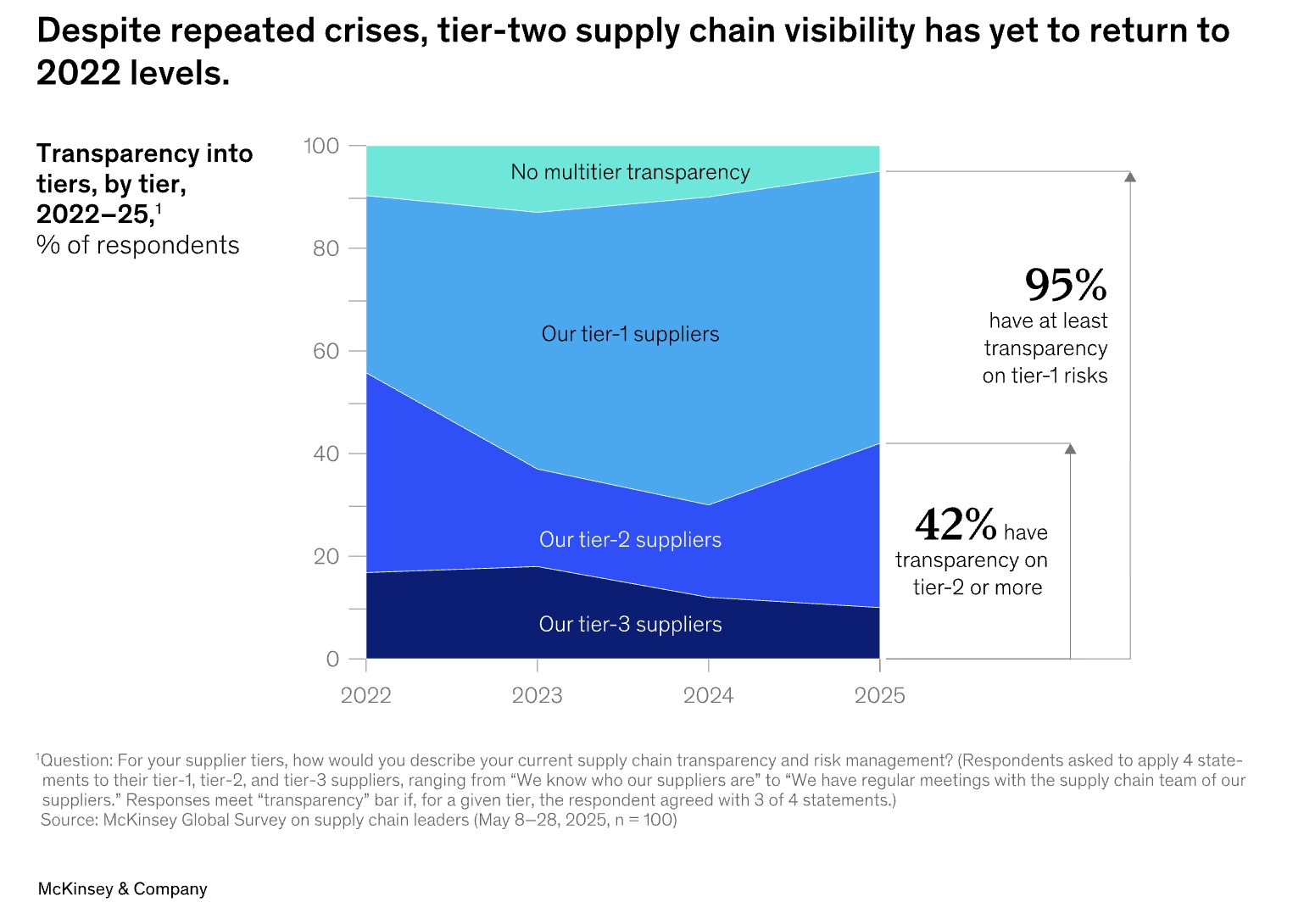
Despite successive crises, tier-2 supply chain visibility has not yet returned to 2022 pre-crisis levels. Tier-2 transparency continues to decline, now standing at just 42% (McKinsey). Digital transformation projects were supposed to solve this, but the results so far are uneven.
What do these mistakes indicate? That tactical responses don’t create strategic resilience, they just compound each other. They reduce anxiety more than they reduce risk. More stock results in more working capital being tied up. An extra layer of ‘Plan B’ suppliers increases network and relationship complexity. Cost pressures drag operations back to optimising for short-term gain. Technology is expected to compensate for structural decisions it was never designed to address. Planning and procurement teams get buried in alerts, delivery exceptions, and incomplete supplier data, slowing intervention instead of improving responsiveness.
The doom loop that deepens fragility
The research indicates a consistent pattern: most OEMs are responding to disruption with the same operational playbook. More inventory, suppliers, reshoring, and technology are being layered onto already complex systems. These responses, each individually rational, together compound supply chain fragility.
The result is often less operational clarity despite increased investment and oversight. Awareness of risk beyond tier-1 has actually declined since 2022, despite years of resilience investments and supplier diversification efforts (McKinsey, 2026). Companies have more data, dashboards and alerts, but not necessarily the right operating systems to understand and act on them effectively.
The supply chain system operates with less certainty despite carrying more inventory and managing more suppliers. And if disruption repeatedly triggers the same reactive behaviours, the problem is no longer the disruption. It is the system design behind it.
Shifting from reactive to operational control
The best OEM supply chains are not necessarily the largest, or those with the most buffer stock or diversification. They’re the ones that allow risks to be identified and addressed before the assembly line, and have the clearest operational control.
Inventory still matters. It’s key to keeping the production line running, but the issue is whether stock is part of a controlled system operating on the best replenishment model, or is used as insurance against uncertainty, as a form of tactical reactivity.
Supply chain strength comes from reducing upstream uncertainty rather than buffering against it downstream. What does this mean operationally? Moving away from static inventory management patched up with emergency expedited deliveries, toward a dynamic system that provides visibility, inventory clarity, intentional replenishment frameworks, and continuous supply chain intelligence.
Most OEMs are missing operational integration
OEM resilience increasingly depends on tighter operational control. The strongest OEM supply systems are not managed or outsourced as disconnected functions. They must coordinate inventory, logistics, and replenishment in a process that is continuously monitored, assessed, and adjusted before a disruption hits production.
At Acorn, this means coordinating a unified logistics support model that enhances supply chain through inventory control, dynamic replenishment and expert supplier coordination. OEMs needing more resilience aren’t helped by disconnected distributors or inventory suppliers; they require trusted supply chain partners that integrate with their operational infrastructure to maintain continuity and enhance control and service under unstable conditions.
The next disruption is inevitable. Your reaction shouldn’t be
In a time of increasing global disruption to supply chains, OEM resilience depends on operational control and integrated supply chain coordination rather than reactive buffering strategies and fragmented logistics responses. Disruption – whether Hormuz, the Red Sea, new tariffs and regulations, or volcanic eruption – is inevitable and semi-continuous.
Volatility in freight, energy, and component supply is no longer temporary; it is structural. And building a system that works under operational pressure, with logistics partners capable of withstanding it, applying control, and adapting to changing conditions, is crucial. Those OEMs who create this operational integration will have the clearest competitive advantage.
Supply chain resilience review
Evaluate how to strengthen operational and inventory control in your system with Acorn’s integrated approach and bespoke logistics services, which we tailor to each client’s operational needs.
We have decades of expertise applying inventory control, replenishment and logistics support for critical manufacturers in the UK.