
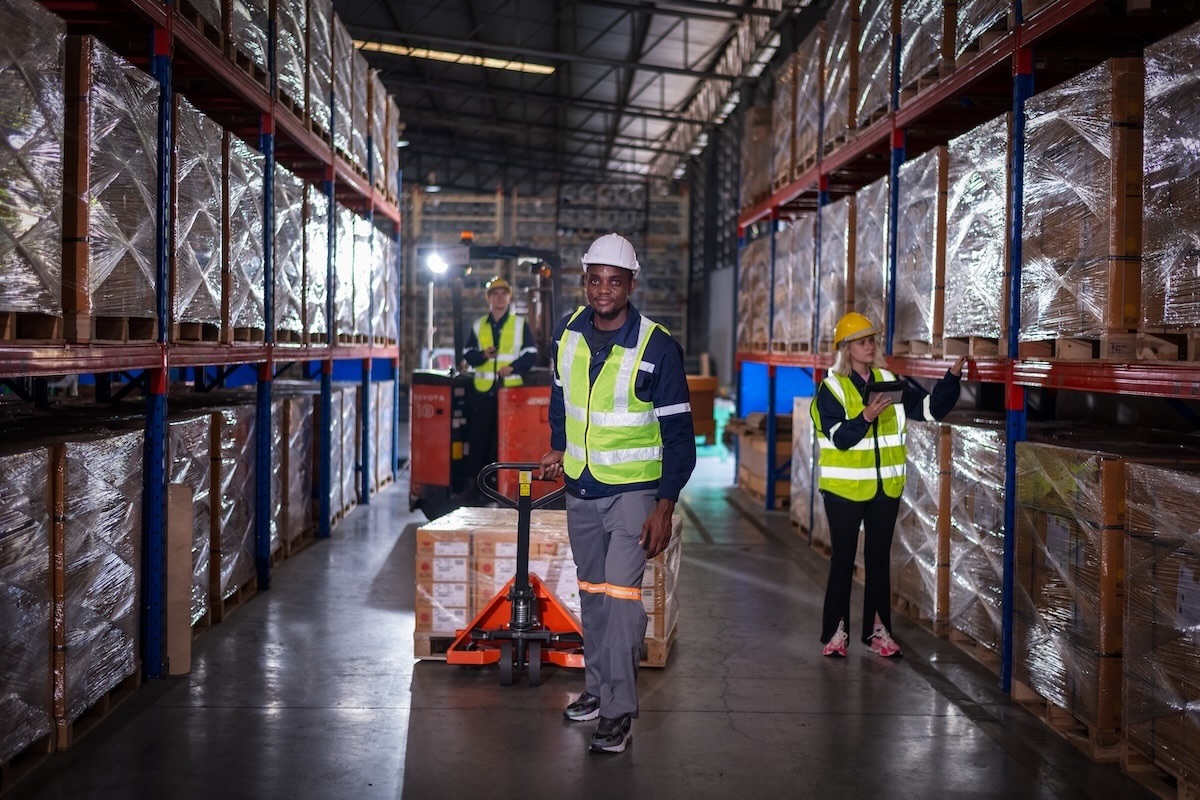
An OEM-optimised off-site warehouse solution enables OEM manufacturers to reclaim floor space and improve on-time delivery (OTD) in one fell swoop. Each square metre of space you use inside your factory for storage is one less available for production.
Many manufacturers keep inventory close at hand for perceived safety and resilience, but if proactive management is lacking factory storage space is often neglected. It’s a pattern we frequently see repeated across client sites we support. Temporary staging areas become permanent, aisles are blocked, and production cells are surrounded by excess parts and packaging. Pallets accumulate and are misplaced, resulting in to untracked and inaccessible inventory. These hidden storage costs undermine delivery performance.
Pressure is both structural and strategic. UK warehousing is amongst the most expensive in Europe (~12-16 per sq.ft, according to Colliers, but double this around Heathrow!). Cost saving and efficient use of space are essential in this context.
What delivers the most value, and what is the best way to do this? Production space should be used for production. Storage space should be used for storage. When these two functions overlap, OTD degrades. The organised, efficient factory floor every operations manager pictures soon gives way to chaos, clutter, and delay.
"Production space should be used for production. Storage space should be used for storage. When the two blur, OTD quietly degrades.
Moving From Stores and Space, to Materials and Flow
The answer is rarely ‘more warehouse’. More often, it is less warehousing (especially on-site) combined with better inventory flow and control. As supply chains become stretched, uncertain, and increasingly complex, stockpiling and buffer stocks are a default safety response.
Unfortunately, this can create a doom loop: more stock fills available space, leading to congestion and higher costs as additional storage is leased. Increased congestion slows response times and reduces inventory efficiency. If inventory cannot be trusted or located, uncertainty and inefficiency result, giving a false sense of security.
McKinsey reports that 45% of firms are increasing inventory levels as a mitigation response to tariffs and supply chain uncertainty. This is a sub-optimal strategy. Overflowing stock won’t help if system visibility is lost and resilience shifts to relying on memory and last minute searches. If you are increasing the touchpoints and friction of moving stock-in through to line delivery, then the internal flow of components becomes less predictable and harder to recover.
The fix lies in smarter warehousing, not more materials in your stores. Reduced and trackable touchpoints. Better visibility and increased control so inventory flows to production with the least effort and intervention. Move in this direction with logistics focussed on fixing these problems and production cells get components flowing to them when they need them. Not before, not after.
Off-Site Warehousing as Part of Production
The trap is to think about off-site warehousing as merely overflow storage. It isn’t about simply offloading storage. Strategically, it’s actually about developing a more efficient, smartly integrated logistics solution with each part focussed on what it does best. Moving control upstream allows for easier and more cost-effective checks, preparation, and allocation.
When connected to your ERP/MRP systems, an integrated facility can apply more control and management, including through QA, kitting and assembly processes readying your componentry for direct delivery to production cells and assembly lines. As it’s dedicated to your inventory management, off-site warehousing with its value-added services can provide predictable delivery, daily drops as well as predictive and on-demand replenishment, including direct line feed (DLF).
A managed and integrated warehouse service aligns with production, and can eliminate inefficient internal stores management, ad hoc goods-in processes, over-ordering, reactive picking, and ‘parts-hunting’. Expertly applied, it streamlines logistics rather than introducing another layer.
A Six-Step Controlled Inventory Flow
When storage and movement are managed properly, warehousing stops being a space-saving tactic and becomes something more: an actual production advantage. A hub for the production-aligned allocation of materials rather than a place to simply store and retrieve parts.
This is the step-by-step operating model we implement with our OEM clients:
- Decouple storage from production.
- Reduce internal touchpoints.
- Apply goods-in controls.
- Stage materials for assembly.
- Align delivery with production.
- Buffer stock monitoring to surface risk.
What happens in each step?
1. Decouple storage from production
Separate long-term storage from active inventory on-site and on the factory floor. Retain only materials needed for immediate build and assembly within production areas. This allows production teams focus to be on assembly, not stock management.
2. Reduce internal touchpoints
Expert off-site storage minimises staging, rehandling, and internal transfer of materials. Master supply and delivery enables fewer hand-offs, simplified flow, and means fewer errors and lower labour costs.
3. Apply goods-in controls
Disciplined goods-in processes mean receipt and verification of stock once, with checks, identification, and location control applied consistently. Directed putaway and FIFO discipline is applied to materials at the start of the production flow.
4. Stage materials for assembly
Inventory staging is allocated against production schedules and live bill of materials (BOMs). Direct line feed replenishment delivers straight to production cells, with materials arriving already checked, with QA, correct quantities, and ready to fit with full custom kitting procedures. Components arrive ready to use at the point of assembly, checked, complete, and verified.
5. Align delivery with production
Delivery sequencing, cut-offs, and quantities are set against live production, supporting uninterrupted assembly. If production demand with proactive staging is matched to delivery schedules, then ad-hoc firefighting and the emergency expediting of materials is extinguished. Internal flow becomes more reliable.
6. Buffer stock monitoring to surface risk
Live stock data flags emerging risks days or weeks in advance, allowing realignment of buffer levels. Before production gets exposed, stock can be expedited, reallocated, or replenished as part of standard procedures, enabling planned action and keeping risk management upstream.
Implementing this disciplined six step structure protects on-time delivery (OTD) and levels up your production advantage.
What Your Team Gains, From Factory Floor to Balance Sheet
You want to achieve both operational confidence and commercial return. Integrated off-site warehousing delivers consistency and efficiency, with trained personnel following standardised processes. Materials arrive ready for assembly, checked, accurate, and in ideal condition. Strategically, this operational change provides multiple performance benefits, protects working capital, and avoids disruption-related costs.
Features that deliver operational confidence:
– ISO-certified facilities (9001, 14001), with dedicated QA and kitting facilities.
– Documented procedures for goods-in, handling, along with despatch.
– Scan-verified receipt, directed putaway.
– Full traceability: lot, batch, revision control.
– FIFO applied at goods-in, not corrected later.
– Consistent handover and procedures for every delivery.
– Tracking and audit-ready systems in place.
Advantages for commercial performance include:
– Production floor space recovered (no need for expansion).
– Refined material flow and movement minimises errors and congestion.
– Labour redeployed from firefighting to value-adding work.
– FIFO compliance reduces obsolescence and write-offs.
– Actively managed delivery schedules for high OTD.
– Line-down avoidance removes high-cost disruption.
– Exception escalation, with issues surfaced upstream, not at point of assembly.
When manufacturers shift logistics execution to specialist partners (whether that’s full 3PL, or other flavours of dedicated off-site warehousing services), operational and commercial outcomes materially improve. 82% see better customer service, with 66% realising cost reductions, according to the 2025 edition of the long-running Third-Party Logistics Study (Penn State/NTT/Penske).
These aren’t theoretical gains; we see this pattern across Acorn clients regularly.
When Off-Site Warehousing Fits, and When It Doesn’t
Off-site warehousing addresses specific difficulties effectively and is especially valuable in today’s environment, where agile and resilient supply chains yield considerable benefits. However, it is not a universal solution.
It is not ideal for low-volume manufacturing with small quantities and frequent design changes. The economics do not justify dedicated services with extended supply network management. If BOMs are frequently revised, staged materials and kitting can become obsolete. Fast-paced engineering environments are a poor fit. Off-site warehousing is most effective when a consistent delivery cadence supports production flow; it is less suitable for purely reactive demand and assembly.
Off-site warehousing is well-suited to complex OEM manufacturing environments, including scenarios such as:
– Space-constrained sites with no room to expand and rising lease costs.
– High-mix manufacturing with multiple SKUs, complex kitting and assembly needs.
– Complex BOMs requiring multi-component assemblies and robust revision control.
– Variable, seasonal, or project-based demand that creates volume swings,
– High OTD expectations with contractual or customer-critical consequences.
– Sectors with strict audit trails and traceability (such as aerospace, medical, defence).
– Where scaling is required, without capital outlay or bloating facilities.
In these settings, it creates a structural advantage over and above logistic effectiveness. It offers control over manufacturing complexity.
Recover Floor Space Fast
To improve inventory and production flow, you do not need a new building. Instead, ensure production space is reserved for production, not storage.
With our clients we assess: current storage footprint and production flow on the factory floor; map internal touchpoints and look at removing friction and redesigning the materials journey to assembly; what delivery options work best (from weekly, daily, to shift-aligned and DLF); where gains can be made for OTD; readiness checks for VMI, kitting, line feed and sub-assembly opportunities.
Get a Process Design Assessment, Reclaim Your Factory
Contact us for a free assessment to recover floor space, redesign your inventory flow, and get the full benefits of off-site warehousing. We provide prioritised, practical actions and clear logistics services that have been developed to improve your operations and commercial outcomes.